28 Oct 2026
Tracing the Historical Progression of Node Networks from Inception to Modern Applications
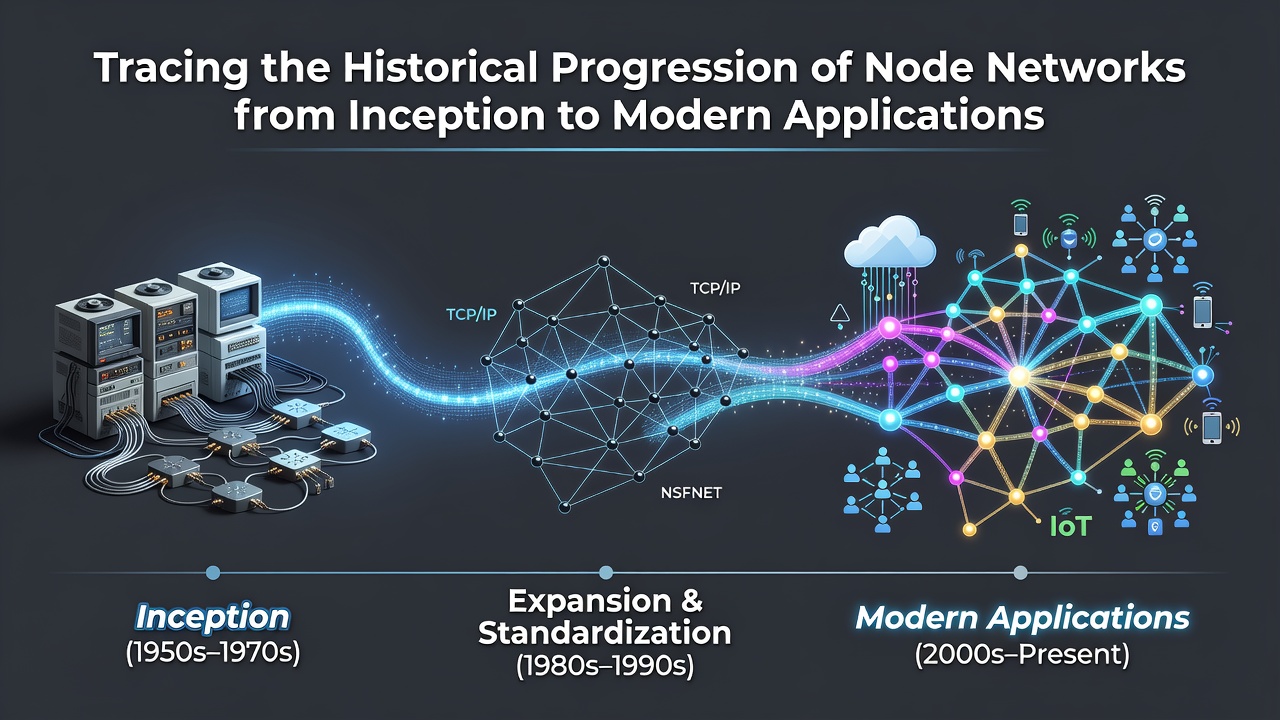
Node networks emerged from foundational efforts in the 1960s when researchers at institutions like the Advanced Research Projects Agency developed packet-switching systems that allowed multiple computers to share data across distributed points; these early configurations treated each connection point as a node responsible for routing and relaying information, establishing the basic architecture that later expanded into larger systems.
Initial Development in Research Environments
The ARPANET project, launched in 1969, connected four university sites and demonstrated how nodes could maintain communication even if individual links failed, and data packets traveled independently through the network while nodes handled addressing and forwarding tasks. Observers note that this approach proved reliable under variable conditions, which encouraged further experiments throughout the 1970s as additional nodes joined and protocols standardized the way messages moved between points.
By the early 1980s government agencies and academic consortia had scaled these networks, and the National Science Foundation supported backbone connections that linked regional clusters; each node performed local traffic management while contributing to overall connectivity, and researchers documented how redundancy across nodes improved resilience against outages.
Expansion During the Commercial Internet Era
Commercial adoption accelerated after the NSFNET transition in 1995 opened the infrastructure to private providers, and node counts grew rapidly as internet service providers established points of presence in cities worldwide. Data shows that the number of autonomous systems, each functioning as a collection of nodes under single administrative control, increased from fewer than 100 in 1989 to several thousand by 1999 according to routing registry records maintained by organizations such as the Internet Assigned Numbers Authority.
Standards bodies including the Internet Engineering Task Force refined protocols that defined node behavior for routing, addressing, and error handling, while equipment manufacturers produced routers and switches optimized for higher throughput at each interconnection point. Those who studied traffic patterns during this period found that node placement decisions directly influenced latency and reliability for end users across continents.
Shift Toward Decentralized and Distributed Models
The late 1990s and early 2000s saw peer-to-peer applications reframe node roles, and systems such as Napster and later BitTorrent allowed ordinary computers to act as both clients and servers within the same network. Each participating device operated as a node that stored fragments of files and forwarded requests, reducing reliance on central servers and demonstrating how node networks could scale through voluntary participation rather than planned infrastructure.
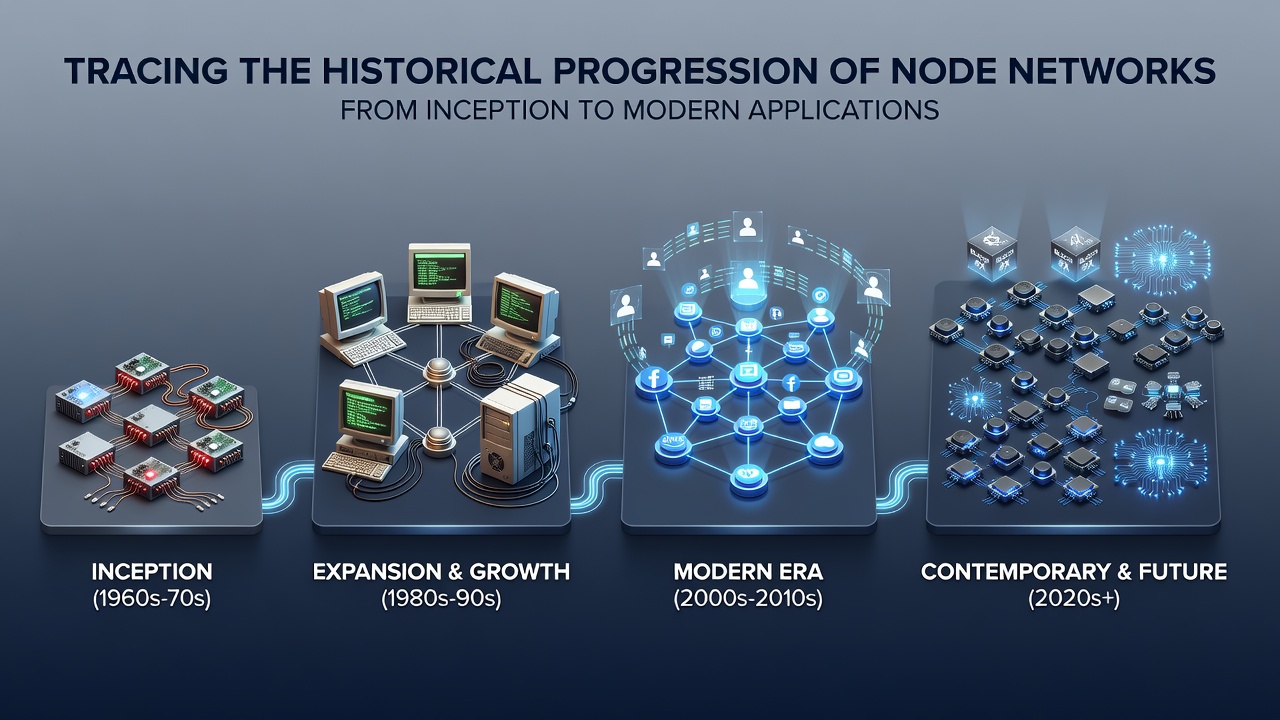
Blockchain technology, introduced with Bitcoin in 2009, further emphasized this model because every full node maintained a complete copy of the ledger and validated transactions independently; developers observed that consensus mechanisms required nodes to communicate frequently, and network health depended on geographic distribution of these validation points. Studies published by academic groups in Europe and North America tracked how node diversity affected resistance to coordinated attacks or censorship attempts.
Contemporary Applications Across Multiple Sectors
Edge computing deployments place processing nodes closer to data sources in manufacturing plants, telecommunications towers, and urban sensor grids, and this arrangement cuts transmission delays while lowering bandwidth consumption on core links. Industry reports indicate that by 2025 the number of edge nodes supporting 5G services had reached several million globally, with telecommunications operators in Asia and North America leading installation rates.
Internet of Things platforms rely on gateway nodes that aggregate readings from sensors before forwarding summarized data, and network operators manage these gateways through centralized dashboards that monitor node status, firmware versions, and connectivity metrics. Government agencies in Canada and Australia have published guidelines on securing such node deployments in critical infrastructure, emphasizing segmentation and regular updates to prevent lateral movement by malicious actors.
In October 2026 several research consortia presented test results from quantum networking experiments that used specialized nodes to maintain entanglement over metropolitan distances, and these demonstrations built on earlier fiber-optic trials conducted in the United States and the European Union. The findings suggested pathways for integrating quantum nodes with existing classical infrastructure without requiring complete replacement of current routing equipment.
Conclusion
Node networks have evolved from limited research prototypes into essential components of global communication, commerce, and scientific collaboration, and their progression reflects continuous refinement of routing logic, hardware capabilities, and governance frameworks. Current deployments span centralized data centers, distributed peer systems, and emerging quantum testbeds, each configuration shaped by the same core principle that originated in the 1960s: information moves most effectively when responsibility is shared among multiple interconnected points. Data from routing registries and deployment statistics continue to document this expansion across regions and industries.